

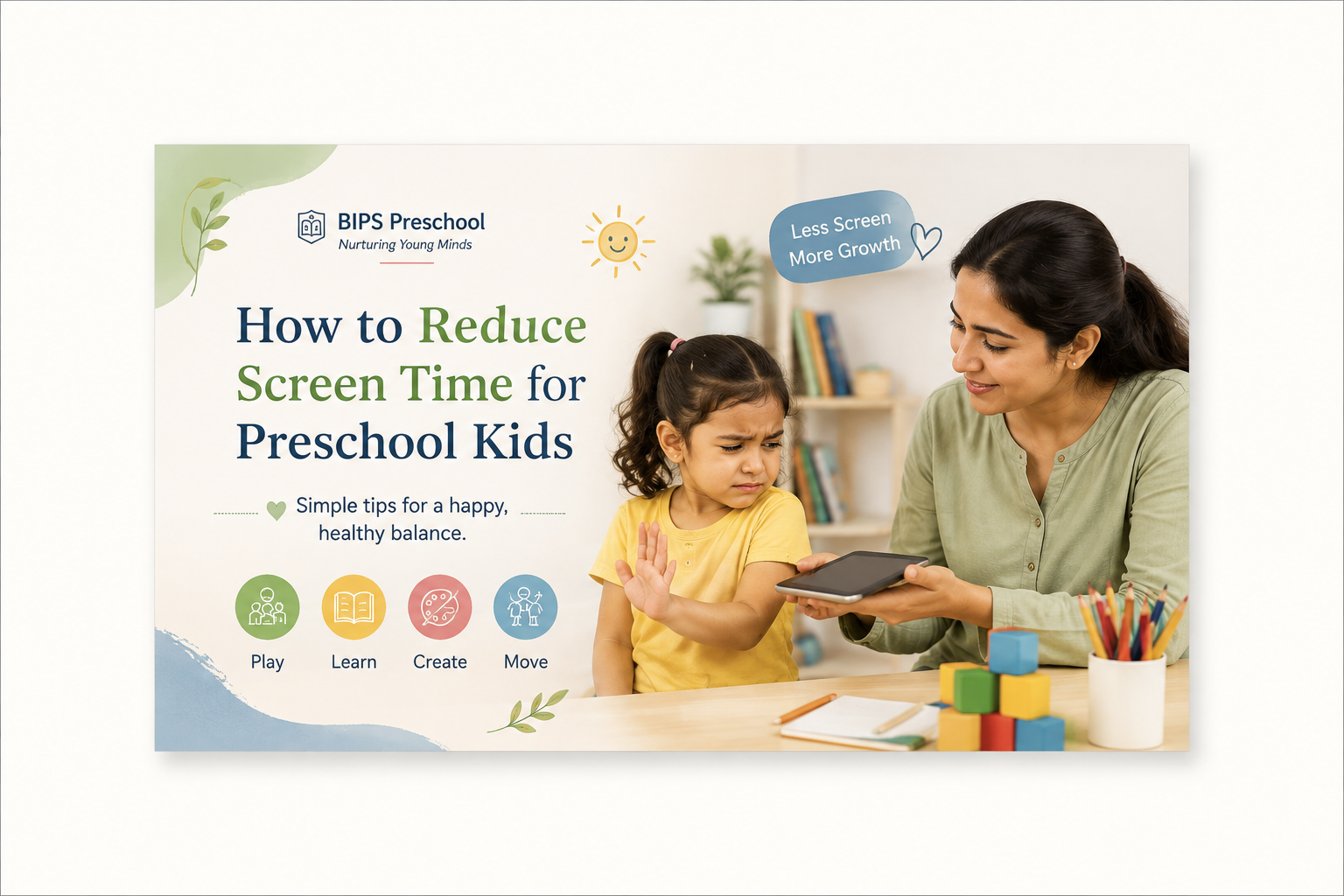
"Just five more minutes!"
If you have a preschool child at home, you have probably heard this sentence many times. Whether it is a cartoon, mobile game, YouTube video, or another favorite show, children can become very attached to screens.
When parents try to switch the television or mobile phone off, the result can sometimes be crying, shouting, arguing, or a full-blown tantrum.
This makes many parents wonder: How can I reduce screen time without making every day a battle?
The good news is that reducing screen time does not have to happen suddenly. A gradual routine, interesting alternatives, and consistency can make the process much easier.
Preschool children need opportunities to talk, move, play, imagine, explore, and interact with people. These experiences are an important part of early childhood education.
A good preschool in Patiala can also encourage children to spend more time in hands-on activities, social interaction, storytelling, creative learning, and physical play.
Why Do Preschool Children Love Screens So Much?
Screens are designed to keep attention.
Bright colors, sounds, music, fast-moving images, and rewards can make digital content very interesting for young children.
A child may choose a screen because it is easier and more immediately exciting than a puzzle, book, or outdoor game.
This does not mean screens are always bad. The important thing is how much time children spend using them and what they are missing because of that time.
Why Too Much Screen Time Can Be a Concern
Young children need a variety of experiences for healthy development.
They need opportunities to:
- Talk with adults
- Play with other children
- Use their imagination
- Develop motor skills
- Explore their surroundings
- Practice communication
- Learn through hands-on activities
If screen time takes up too much of the day, children may have fewer opportunities for these experiences.
This is why parents often look for ways to create a healthy balance between technology and real-world activities.
Don't Remove Screens Suddenly
One of the biggest mistakes parents make is switching from unlimited screen time to zero screen time overnight.
If a child is used to watching cartoons for several hours, suddenly removing the device can lead to frustration.
Instead, make changes gradually.
For example, if your child currently spends two hours watching videos, reduce the time slowly and replace some of that time with another enjoyable activity.
Give Your Child a Warning Before Screen Time Ends
Children do not always understand why a screen suddenly disappears.
Give them a warning:
"Five more minutes, then we are going to have lunch."
You can give another reminder when there is one minute left.
This gives the child time to prepare mentally for the change.
Create a Daily Routine
A predictable routine makes screen-time limits easier to follow.
For example:
Morning: Breakfast → Getting ready → Preschool
Afternoon: Lunch → Rest → Creative activity
Evening: Outdoor play → Dinner → Storytime
Night: Bath → Story → Sleep
When children know what comes next, they are less likely to negotiate for screen time throughout the day.
Offer Interesting Alternatives
Simply saying "No phone" is not enough.
Give children something else to do.
Storytelling
Read picture books or tell short stories together.
Storytelling improves listening, vocabulary, imagination, and communication.
Art and Craft
Give children crayons, paper, clay, or age-appropriate craft materials.
Building Games
Blocks, puzzles, and construction toys encourage problem-solving.
Outdoor Play
Cycling, running, ball games, and simple outdoor activities help children stay active.
Pretend Play
Children can play shopkeeper, teacher, doctor, chef, or other imaginative games.
These activities can be much more engaging when parents participate.
Make Screen-Free Time a Family Habit
Children learn from adults.
If parents constantly use their phones during family time, children naturally want to use them too.
Try creating certain screen-free periods for everyone.
For example:
- During meals
- During family conversations
- Before bedtime
- During outdoor activities
When the entire family follows the rule, children are less likely to feel that they are being punished.
Use Screens as Part of a Routine, Not a Reward for Everything
It can be tempting to say:
"Finish your food and I'll give you the phone."
Or:
"Clean your toys and you can watch cartoons."
Occasionally this may work, but making screens the reward for every task can increase their value in the child's mind.
Instead, help children understand that screen time is simply one activity among many.
Encourage Independent Play
Parents do not need to entertain children every minute.
Give them safe opportunities to play independently.
You can provide:
- Building blocks
- Drawing materials
- Picture books
- Puzzles
- Dolls
- Pretend-play sets
- Sorting activities
At first, children may complain that they are bored. This is normal.
With time, many children learn to create their own games.
How Preschool Can Help
A quality preschool gives children many opportunities to learn without screens.
At BIPS Preschool, children can participate in activities such as storytelling, creative work, practical learning, group interaction, movement, and hands-on educational activities.
These experiences help children discover that learning can be enjoyable without a digital device.
Parents searching for the best playschool in Patiala can consider how a school's learning environment supports creativity, social interaction, communication, and physical activity.
Montessori Learning and Hands-On Activities
Parents considering Montessori schools in Patiala often value hands-on learning.
Montessori-inspired activities encourage children to work with physical materials, explore concepts, practice practical life skills, and develop concentration.
Instead of simply watching something happen on a screen, children can touch, move, arrange, sort, build, and solve.
This active learning approach supports curiosity and independence.
What If My Child Has a Tantrum?
Stay calm.
If the child cries or becomes angry when screen time ends, avoid immediately giving the device back simply to stop the tantrum.
A calm response can be:
"I know you want to keep watching. Screen time is finished now. You can choose between drawing or building blocks."
The goal is not to win an argument. It is to teach the child that limits are consistent and emotions can be handled calmly.
Be Consistent
If screen time ends at 7 PM on some days but continues until 10 PM on others, children may keep negotiating.
Consistency makes boundaries easier to understand.
Parents should also remember that occasional exceptions do not mean the routine has failed. What matters is the overall pattern.
FAQs
How much screen time should a preschool child have?
The appropriate amount depends on the child's age, content, family routine, and other activities. Parents should follow current pediatric guidance and focus on ensuring that screens do not replace sleep, physical activity, family interaction, or learning through play.
How can I reduce screen time without tantrums?
Reduce screen time gradually, give warnings before switching it off, create a predictable routine, and offer interesting alternatives.
Why does my child get angry when I take away the phone?
Screens are highly engaging, so children may find it difficult to stop an enjoyable activity. Consistent boundaries and transition warnings can help.
What are good screen-free activities for preschool children?
Storytelling, drawing, puzzles, blocks, pretend play, music, outdoor games, simple household activities, and reading are excellent options.
Can preschool help reduce a child's dependence on screens?
A good preschool provides opportunities for hands-on learning, social interaction, creative activities, movement, and communication, giving children enjoyable alternatives to screen-based entertainment.
Is Montessori education good for children who use too much screen time?
Montessori-inspired learning emphasizes hands-on activities, practical life skills, concentration, independence, and exploration, which can provide meaningful screen-free learning experiences.
Conclusion
Reducing screen time does not have to mean taking technology away completely. The goal is to create a healthy balance where children have enough time for sleep, physical activity, family interaction, social play, reading, creativity, and hands-on learning.
Start with small changes. Set predictable limits, give children alternatives, and remain consistent even when they test the boundaries.
With support from parents and a good early learning environment, children can discover that there is a whole world of fun beyond the screen.