

Choosing a preschool is an important decision for every parent. The early years of a child are a time of fast learning and development. Children learn how to communicate, make friends, follow routines, solve simple problems and become more independent.
Many parents are now interested in Montessori education because it gives children opportunities to learn through hands-on activities, practical work and independent exploration. However, not every school that uses the word "Montessori" follows the same approach.
Before choosing a Montessori school, parents should look at more than the name. They should understand the learning method, teachers, classroom environment, activities, safety and overall care provided to children.
If you are looking for a Montessori school in Patiala, here are some important things to check.
1. Understand the Montessori Method
The first thing parents should understand is what Montessori education means.
Montessori education focuses on learning through hands-on activities and real-life experiences. Children are encouraged to explore materials, practise skills and work with increasing independence.
Instead of expecting every child to learn the same thing at exactly the same time, a good Montessori environment gives children opportunities to learn according to their stage of development.
Parents should ask the school how Montessori principles are used in everyday classroom activities.
2. Look at the Classroom Environment
The classroom is an important part of Montessori learning.
A Montessori classroom should be organised, clean and welcoming. Learning materials should be placed where children can reach and use them safely.
Look for:
- Child-sized furniture
- Well-organised shelves
- Age-appropriate learning materials
- Reading areas
- Practical life activities
- Art and creative activities
- Space for individual and group activities
The classroom should allow children to move around safely and choose suitable activities with guidance from teachers.
3. Check the Montessori Learning Materials
Montessori classrooms use specially designed learning materials that help children understand concepts through touch and practice.
These may help children learn:
- Numbers
- Letters
- Shapes
- Colours
- Sizes
- Counting
- Language
- Fine motor skills
- Practical life skills
Parents should ask to see the materials used in the classroom.
It is also important to ask whether children actually use these materials regularly or whether they are mainly used as decoration.
4. Ask About the Teachers
Teachers have a major role in a child's early education.
Parents should ask about:
- Teacher qualifications
- Montessori training
- Teaching experience
- Experience with young children
- Teacher-child interaction
- Classroom support
A good early-years teacher should be patient, caring and able to understand the different needs of young children.
Observe how teachers speak to children during your school visit. Do they listen to children? Do they encourage them? Do they give children time to try things themselves?
These small details can tell parents a lot about the classroom environment.
5. Look for Individual Attention
Young children develop at different speeds.
One child may start speaking early, while another may take more time. One child may enjoy numbers, while another may prefer stories, art or practical activities.
Parents should ask how the school supports individual learning needs.
A good Montessori environment should give teachers opportunities to observe children and understand their progress.
Instead of comparing children with one another, teachers should encourage each child to develop gradually.
6. Check How Independence Is Encouraged
One important part of Montessori education is helping children become more independent.
Young children can learn simple tasks such as:
- Putting toys back
- Washing hands
- Carrying their own things
- Pouring water
- Buttoning clothes
- Arranging materials
- Cleaning after an activity
- Choosing an activity
These simple tasks can help children develop confidence and responsibility.
Parents should ask how the school encourages children to do things independently while providing help when needed.
7. Ask About Practical Life Activities
Practical life activities are an important part of Montessori learning.
These activities connect classroom learning with everyday life.
Children may practise:
- Pouring
- Sorting
- Folding
- Cleaning
- Arranging objects
- Opening and closing containers
- Buttoning
- Simple food preparation
These activities can support concentration, coordination and independence.
Parents should ask whether practical life activities are a regular part of the Montessori programme.
8. Check Language Development Activities
Early childhood is an important period for language development.
A good preschool should give children many opportunities to listen, speak and communicate.
Look for activities such as:
- Storytelling
- Picture books
- Rhymes
- Conversations
- Songs
- Vocabulary activities
- Show and tell
- Group discussions
Parents can also ask how teachers help children who are shy or take more time to communicate.
9. Ask About Early Mathematics Learning
Montessori mathematics activities can introduce children to numbers and basic mathematical ideas through hands-on learning.
Children can learn concepts such as:
- Counting
- Number recognition
- Quantity
- Shapes
- Sizes
- Patterns
- Basic addition concepts
The aim should be to help children understand concepts instead of simply asking them to memorise numbers.
10. Check Outdoor Play and Physical Activities
Learning is not limited to classroom activities.
Young children need opportunities to move, play and develop physical skills.
Ask the school about:
- Outdoor play
- Sports activities
- Indoor physical activities
- Playground safety
- Movement activities
Physical activity can also give children opportunities to learn teamwork, sharing and following simple rules.
 11. Check Safety and Cleanliness
Safety should be one of the first things parents check.
During a school visit, look at:
- Entry and exit arrangements
- Playground safety
- Classroom cleanliness
- Washrooms
- Drinking water
- First-aid facilities
- School transport arrangements
- Visitor management
- Emergency procedures
Parents should feel comfortable asking the school how it handles accidents, illness and emergencies.
12. Ask About School Routine
Young children usually benefit from a simple and predictable routine.
Ask what a normal school day looks like.
For example, the routine may include:
Arrival → Classroom activity → Group activity → Snack → Outdoor play → Learning activity → Story time → Departure
A good routine can help children understand what happens next and gradually become more comfortable at school.
13. Look at the Teacher-Child Relationship
During your visit, watch the children.
Do they appear comfortable with their teachers?
Do teachers speak calmly?
Do teachers listen when children ask questions?
Do children get opportunities to explore?
These observations can be very useful when parents are comparing Montessori schools.
14. Ask How Parents Receive Updates
Parents should know how their child is progressing.
Ask whether the school provides:
- Parent-teacher meetings
- Progress updates
- Activity reports
- Communication through an app or other system
- Information about classroom activities
- Feedback about the child's development
Good communication between parents and teachers can help support the child's learning at home and school.
15. Visit the School Before Admission
Online information can help parents create a shortlist, but visiting the school can provide a better understanding of the environment.
During the visit:
- Walk through the classrooms.
- Meet teachers.
- Look at learning materials.
- See the playground.
- Ask about the daily routine.
- Discuss safety.
- Understand the admission process.
- Ask about fees and other charges.
Parents should feel free to ask questions before making a decision.
Questions Parents Should Ask a Montessori School
Before admission, parents can ask:
- What Montessori activities are included in the daily routine?
- Are the teachers trained in Montessori education?
- How many children are there in each classroom?
- How does the school support individual learning?
- What practical life activities are offered?
- How much outdoor play do children get?
- How are parents updated about their child's progress?
- What safety measures are in place?
- How does the school handle separation anxiety?
- What is the daily school routine?
The answers can help parents understand whether the school is suitable for their child.
Montessori School in Patiala: What Parents Should Consider
Parents looking for a Montessori school in Patiala have several factors to consider. Location is important, but it should not be the only factor.
Parents should compare the school's:
- Montessori approach
- Teachers
- Classroom environment
- Learning materials
- Safety
- Outdoor activities
- Child care
- Parent communication
- Daily routine
- Overall learning environment
The right school should provide a safe and supportive place where children can learn, explore and gradually become more independent.
For parents considering BIPS Preschool in Patiala, the Montessori programme focuses on providing young children with opportunities for early learning, practical activities and overall development. Parents can contact the school directly to understand the current programme, age groups and admission process.
Final Thoughts
Choosing a Montessori school is not only about finding a school with a Montessori name. Parents should look at how children actually learn and interact in the classroom.
A good Montessori environment should encourage curiosity, independence, concentration, communication and practical skills while giving children time to explore and learn.
Before admission, visit the school, meet the teachers, observe the classroom and ask questions.
Most importantly, think about your child's needs.
Every child is different. The right Montessori school should provide a safe, caring and positive learning environment where your child can enjoy learning and develop confidence step by step.
Frequently Asked Questions
1. What should parents look for in a Montessori school?
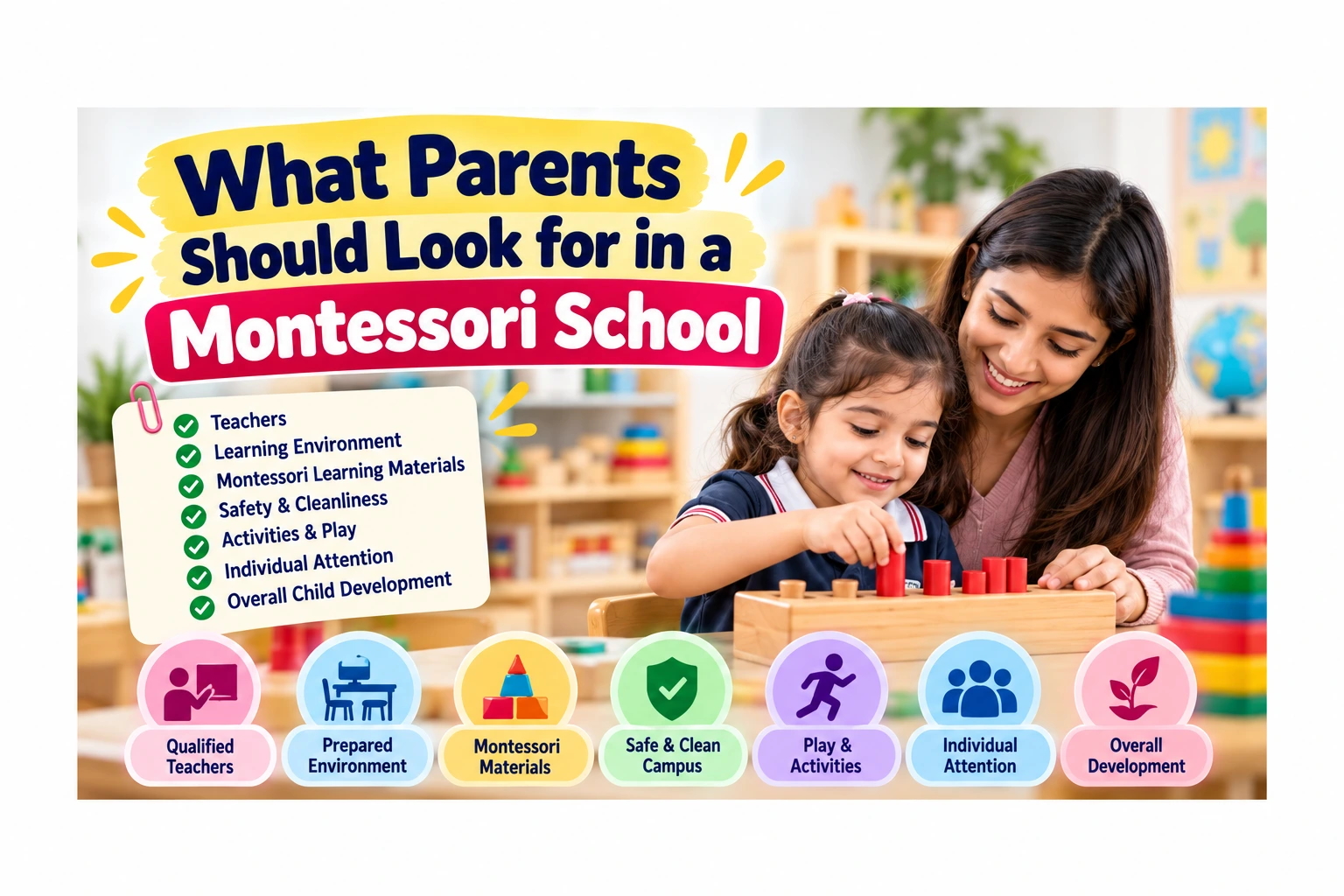
Parents should check the teachers, Montessori learning materials, classroom environment, safety, practical life activities, outdoor play, individual attention and communication with parents.
2. What makes a good Montessori classroom?
A good Montessori classroom should be organised, clean and child-friendly. Children should have access to suitable learning materials and opportunities for independent, hands-on learning.
3. Are Montessori teachers specially trained?
Parents should ask each school about the qualifications and Montessori training of its teachers. Training and experience can vary between schools.
4. What are practical life activities in Montessori?
Practical life activities are simple everyday tasks such as pouring, sorting, cleaning, folding and arranging objects. They help children practise coordination, concentration and independence.
5. Is Montessori education suitable for every child?
Montessori education can be suitable for many children, but every child is different. Parents should visit the school and understand its teaching approach before making a decision.
6. What age is suitable for Montessori education?
The suitable age depends on the child's development and the programme offered by the school. Parents should check the school's age groups and admission requirements.
7. Does Montessori education focus only on academics?
No. Montessori education can include academic learning along with practical life skills, communication, independence, social development and other activities.
8. How can parents check if a Montessori school is good?
Visit the school, observe the classroom, talk to teachers, look at learning materials and ask about the daily routine, safety and child development.
9. What questions should I ask before Montessori admission?
Ask about teacher training, classroom size, daily activities, learning materials, safety, outdoor play, parent communication, fees and the school's approach to child development.
10. How does Montessori education help children become independent?
Children are given opportunities to complete simple tasks themselves, choose suitable activities and take care of classroom materials. Teachers guide them when help is needed.
11. Is outdoor play important in Montessori preschool?
Yes. Outdoor play and physical activities give young children opportunities to move, explore and develop physical and social skills.
12. How important is the Montessori classroom environment?
The classroom environment is very important. A well-organised and child-friendly environment can give children opportunities to explore, practise skills and become more independent.